
Work/Life Balance
Welcome to my first blog!
Each week we will tackle a topic of importance in our world related to the way our brain perceives emotions, social wellbeing, growth, trauma, and more. I’d like to start this series with the subject matter of the Wellness Model.
The Wellness Model in psychology refers to our physical, mental/emotional, spiritual, social, and career/financial health. My personal take as a counselor also includes our technological health, which we will get into in subsequent blogs. As you start your journey in therapy, ask yourself “what do I want to focus on in each of these dimensions?” Are you lacking growth in one of these dimensions more than another? Are you focusing too much on one and disregarding another? The whole idea here is to have a balance in each of these pillars so that they can remain a strong foundation for our health.
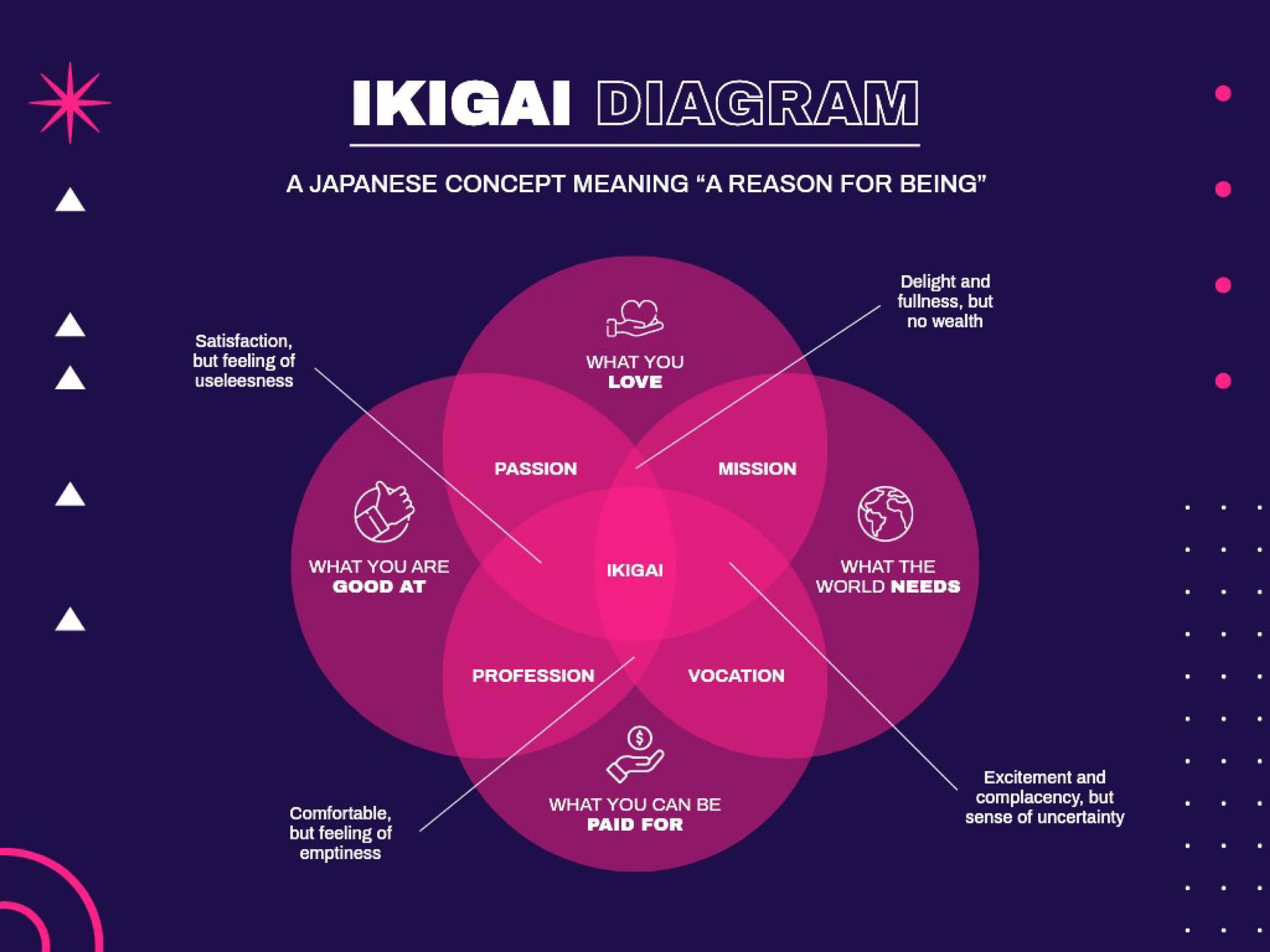
Ikigai Diagram: A Japanese Concept Meaning “A Reason for Being”
You may notice that you spend almost all of your time at work or the gym while ignoring other parts of your health. You may isolate yourself from social events or procrastinate creating them on your own. You might not have an idea of what spirituality means to you. You could be at a crossroads with your job and wonder what direction should I go in my career? All of these can be focal points for us to look at the balance we have in our lives.
I often bring up Eastern philosophy in my work as a counselor and the Japanese idea of Ikigai (García, H., & Miralles, F., 2017) often comes up in relation to our career health. Ikigai is the balance found in the work that we do that implies 4 major components in how we work with the world. What you love, what the world needs, what you can get paid for, and what you are good at are the areas that we can look at for a holistic take on our relationship with work. You may be thinking of jobs you have had that one of these dimensions was the most prominent. You may have had jobs in which almost all of these were fulfilled. As we take a deeper look at who we are in the world, there is always a chance at reflecting if our needs are being met. I offer this opportunity to reflect on some aspects of your current work and to look at what aspect of Ikigai you would like to incorporate more of. Join us next week for another iteration of Psychblogs with Clarity Minds Counseling!
References: García, H., & Miralles, F. (2017). Ikigai: The Japanese secret to a long and happy life (R. Cleary, Trans.). Penguin Books. https://www.amazon.com/Ikigai-Japanese-Secret-Long-Happy/dp/0143130722 https://medium.com/@morena.rodriguezcesar/ikigai-the-japanese-secret-to-a-long-an d-happy-life-4e2d08023713

Meet the Author:
Joey Crispino, Masters’ Intern
I focus on addressing the impact of anxiety, depression, ADHD, OCD, and technology on adolescents, the family, and couples. I have experience counseling seniors and am familiar with aspects of grief counseling.